
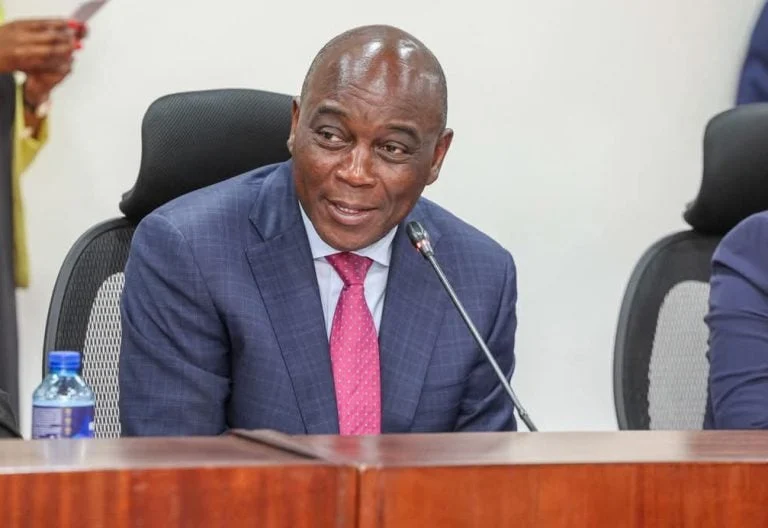

Political tensions flared on Wednesday night after lawyer Miguna Miguna publicly questioned the source of businessman and politician Caroli Omondi’s wealth following explosive remarks made during an appearance on the JKL Live hosted by Jeff Koinange.
Speaking on the live television interview, Omondi revealed that he had significantly financed the Orange Democratic Movement (ODM) in past election cycles. He claimed that in 2013 alone, he spent approximately KSh 700 million on the party, including campaign materials and vehicles. He further stated that in 2017, he had set aside $2 million for ODM but declined to release the funds after he was denied a party nomination certificate.
Omondi argued that heavy spending in politics has distorted Kenya’s democratic space, calling for the urgent enactment of a comprehensive campaign financing law. According to him, the high cost of elections has sidelined young leaders with strong ideas but limited financial muscle.
However, his disclosures quickly drew sharp criticism from Lawyer Miguna Miguna, who took issue with Omondi’s financial trajectory. Miguna pointed out that Omondi previously served as Administrative Secretary in the office of former Prime Minister Raila Odinga, earning a reported monthly salary of KSh 250,000 at the time. He questioned how Omondi rose from that position in 2008 to becoming a billionaire within a few years.
“As the Administrative Secretary in PM Raila Odinga’s office, Mr. Caroli Omondi’s salary was KES 250,000 per month. When he took over that position in 2008, he wasn’t a multi millionaire. However, within 3 years, he was a billionaire and he now boasts of having spent Ksh 700,000,000 on ODM in 2013 and “had $USD 2 million for ODM in 2017.”
Miguna further challenged the moral standing of leaders seeking to position themselves as alternatives to President William Ruto, suggesting that past associations and alleged financial dealings must be subjected to public scrutiny.
During the interview, Omondi also criticized ODM’s internal leadership transitions, arguing that party constitutional procedures were not followed after changes at the top. He claimed that deputy party leaders should have assumed interim leadership roles rather than what he described as the “parachuting” of an individual who previously held no official position within the party.
Additionally, Omondi alleged that funds had been released to certain local political actors in Kakamega with the intention of disrupting an upcoming political function, further escalating tensions within opposition ranks.
The revelations have sparked debate across political circles, with questions emerging over campaign financing, internal party democracy, and the growing influence of private wealth in Kenya’s electoral politics. #Caroli #Miguna