
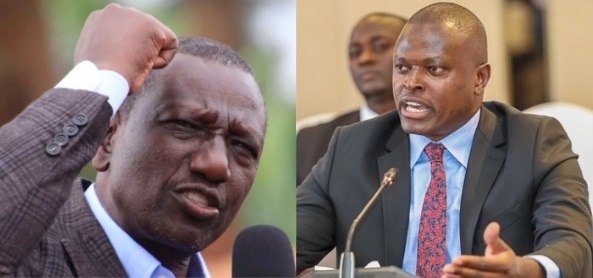

President William Ruto on Friday strongly defended the government’s decision to sell shares in state-owned enterprises, dismissing criticism from leaders he accused of political posturing and intellectual dishonesty.
Speaking while addressing interns, the Head of State appeared to take aim at Kiharu Member of Parliament Ndindi Nyoro, questioning why some leaders who previously supported the divestiture of public assets were now raising objections.
The President expressed frustration over what he termed shifting goalposts, noting that critics were demanding explanations on negotiations and committees involved in the share sales despite earlier consensus on the need for privatization.
“Some people keep asking why we are doing this and claiming it is wrong. The other day, they agreed that we must divest, and now they are asking who negotiated and which committee was involved,” Ruto said. “Any public listed company, every sale is done through the Capital Markets Authority, not committees.”
Ruto warned leaders against what he described as political gimmicks meant to mislead the public, insisting that his administration would not be distracted from its development agenda.
“I want to tell those gentlemen to spare us their political companionship and intellectual deceit. We are not interested in gimmicks. We are moving this country forward,” he said.
The President reiterated his ambition to fundamentally transform Kenya’s economy, urging young people to believe in the country’s future.
“I am going to change this country from a first world to a second world,” Ruto declared. “This will happen. Believe in yourselves as we move this country forward.”
He highlighted the Kenya Pipeline Company share offer as a major milestone, saying ordinary Kenyans can now participate in ownership with as little as Ksh 100 — a move he described as unprecedented.
Ruto revealed that the government plans to raise Ksh 110 billion through the Kenya Pipeline initiative within the next month, alongside an additional Ksh 240 billion from the divestiture of shares in Safaricom. Combined, the funds are expected to inject Ksh 350 billion into government projects.
According to the President, the proceeds will play a critical role in financing key development programs across the country.