
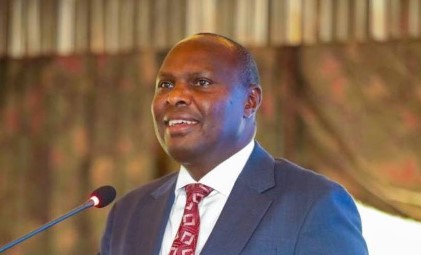

Chief of Staff and Head of Public Service Felix Koskei has called on Kenyans to take a firm and lawful stand against graft, urging citizens to play a direct role in confronting the vice whenever it occurs, signaling a shift in accountability from government officials to the public.
Koskei emphasised that the fight against corruption must go beyond rhetoric, urging individuals at all levels of society to act deliberately against the vice. He urged citizens not to remain silent when faced with corrupt practices.
“Let us make it so shameful and unfashionable for anyone not only to think about corruption but also to proceed and engage in it,” he said, addressing government administrators on Wednesday, June 21, 2023.
He further called on Kenyans to interrupt, challenge, and report corruption through established legal channels, insisting that citizens must stand firm and refuse to be compromised.
The Head of Public Service’s call comes amid government efforts to combat corruption through legislation, institutional reforms, technological integration, and public accountability drives. President William Ruto recently signed the Conflict of Interest Act, 2025, which introduces stricter rules for public officers, including mandatory wealth declarations and a ban on self-dealing.
The National Council on the Administration of Justice (NCAJ) launched an anti-corruption strategic framework to enhance investigations, prosecutions, and asset recovery, while the Ethics and Anti-Corruption Commission (EACC) unveiled the Kenya Integrity Plan (KIP) 2023–2028 to strengthen integrity in both public and private sectors.
Despite these measures, Transparency International’s 2024 Corruption Perceptions Index (CPI) scored Kenya at 32 out of 100, highlighting widespread perceptions of corruption in the public sector. Critics argue that the government’s repeated calls for citizen-led accountability shift the burden of combating graft onto ordinary Kenyans, even as high-profile scandals and daily experiences with bribery persist.
This repositioning has sparked debate over whether citizens can realistically be expected to shoulder the responsibility for systemic corruption, or whether the onus should remain on government institutions to enforce integrity.
Arrest the police before you want us to be responsible
You are quite right. The police as well as corrupt State officials