
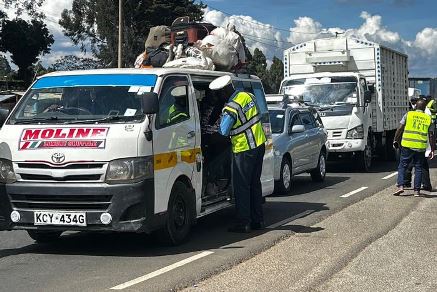

The National Transport and Safety Authority (NTSA) has introduced mandatory eyesight testing for all drivers in Kenya, following a sharp rise in road accidents attributed to poor visibility. The phased nationwide programme was officially launched in Nairobi County, with the authority saying the move is aimed at reducing preventable deaths caused by impaired vision.
The directive comes after alarming statistics showed that in the first 20 days of 2026 alone, more than 40 people lost their lives in road accidents – the highest number ever recorded within such a short period at the start of the year.
NTSA plans to screen every licensed driver in the country at no cost. On the first day of the rollout, more than 200 drivers were tested in Nairobi County, signalling what the authority described as a strong public response to the initiative.
According to NTSA, poor eyesight at night has been identified as a major contributor to fatal crashes, especially during long-distance travel on poorly lit highways. The authority noted that drivers often struggle to detect pedestrians, stalled vehicles, and road signage in time, increasing the risk of deadly collisions.
Kenya recorded 4,458 road accident fatalities in 2025, representing a 3.4 per cent increase from the 4,311 deaths reported in 2024. Pedestrians were the most affected, accounting for 1,685 deaths, followed by motorcyclists with 1,148 fatalities and passengers with 723 deaths. Rear-seat passengers recorded 432 deaths, drivers 403, and pedal cyclists 67 nationwide.
Nairobi County recorded the highest number of fatalities at 447, followed by Kiambu County with 387 deaths and Nakuru County with 318 fatalities.
NTSA attributed the rising death toll to speeding, drunk driving, driver fatigue, poor visibility, and non-compliance with safety regulations. The authority has previously conducted enforcement drives on medical fitness and eye-testing, most notably in June 2023.
The regulator reiterated that most fatal journeys occur at night, when poor visibility combines with other risky behaviours. Kenya last enforced a nationwide ban on night travel for long-distance public service vehicles in December 2017 following the Migaa crash that killed 31 people, though the ban was later lifted by the courts.
The new eye-testing programme follows recent regulations barring suspended drivers from operating under registered SACCOs and requiring retraining before licence reinstatement. NTSA says the initiative underscores its renewed focus on addressing human factors behind road accidents and enhancing safety on Kenyan roads.