
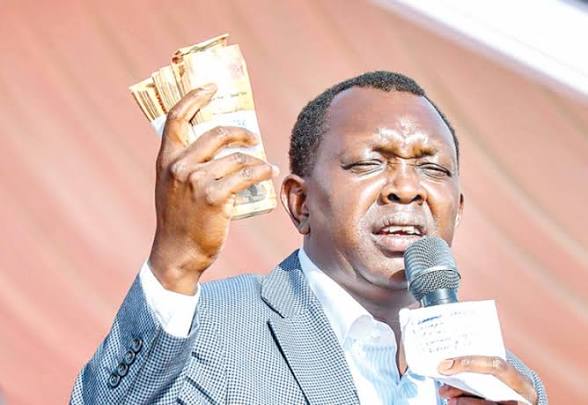

A worrying political culture is taking root across Kenya, and it should concern every citizen who believes in accountable leadership. Politicians are increasingly competing over who can distribute the most cash at public gatherings, branding these donations as “empowerment” while using them to cultivate political support.
Recent events paint a troubling picture. Nairobi senatorial aspirant Jalang’o donated millions of shillings during a youth and women’s empowerment event in Kileleshwa. President William Ruto also contributed millions at a similar function, while Energy Cabinet Secretary Opiyo Wandayi reportedly dished out more money even as he urged Kenyans not to question the source of such generous donations.
In Bungoma, Kimilili MP Didmus Barasa was seen handing out cash to residents, while Governor Kenneth Lusaka and Ruto’s side Farouk Kibet spoke openly about increasing handouts from KSh200 to KSh500 per person.
This week also, PS for Interior Raymond Omollo was in Vihiga where he flew his chopper to meet Bodaboda operators. He also handed them Ksh2000 each which he described as empowerment.
Whether these actions are presented as generosity or empowerment, they raise serious questions about the future of Kenya’s democracy.
True empowerment is not measured by the amount of cash distributed during political rallies. It is measured by access to quality education, affordable healthcare, employment opportunities, reliable infrastructure, and policies that improve people’s livelihoods. A few hundred shillings handed out during a public meeting may provide temporary relief, but it does nothing to address the structural challenges facing millions of Kenyans.
Even more concerning is the message this culture sends to voters. It encourages citizens to associate leadership with personal rewards rather than competence, integrity, and performance. Elections risk becoming contests of financial muscle instead of debates about ideas, policies, and solutions. Those with the deepest pockets gain an unfair advantage, while capable leaders without vast financial resources are pushed aside.
Kenyans also have a right to ask where these millions originate. Public officials and political leaders should welcome scrutiny, not discourage it. Transparency and accountability are fundamental principles of good governance. Whenever large sums of money are distributed publicly, legitimate questions about their source should not be dismissed – they should be answered.
The responsibility does not lie with politicians alone. Citizens must reject the temptation to exchange their democratic voice for short-term financial gain. A handout lasts a day; good leadership can transform lives for generations.
Kenya deserves a political culture built on ideas, service, accountability, and sustainable development – not one driven by cash giveaways disguised as empowerment. If this trend continues unchecked, the country risks normalizing a system where public support is bought instead of earned, weakening democracy and undermining the very principles upon which it stands.
President Ruto splashes Ksh2,500,000 at an empowerment event in Kileleshwa, Wandayi splashes over Ksh2,000,000 as he lectures Kenyans against questioning the source of millions the broad-based politicians dish out in various empowerment drives across Kenya pic.twitter.com/r9nHyv5W9h
— Lightcast TV Kenya (@Lightcasttvke) July 5, 2026